

North Korean Missile Precision Improvements and the Russo-Ukrainian War
A quick point on improvements in the Hwasong-11A (and other North Korean missiles).

A short Nukesletter today, putting a finer point on an observation that I keep making in a variety of conversations, but haven’t written about much.
I had the pleasure of joining fellow North Korean analysts Arius Derr (one of my former editors!), Rachel Minyoung Lee, and Vann Van Diepen today for a panel on the ongoing North Korean Workers’ Party Congress at the Korean Economic Institute of America. You can watch the discussion here:
I wanted to use this Nukesletter to just highlight a point that I think is rather germane to the conversation about the myriad ways in which I believe North Korea has benefited from its partnership with Russia and, specifically, from the use of its ballistic missiles against Ukraine (the first such use of its missiles in war ever).
As best we understand in the open source, North Korean Hwasong-11A-series (KN23) solid propellant short-range ballistic missiles first arrived in Russia for use against Ukraine in the final months of 2023 (as early as November, but possibly earlier). The earliest deliveries appeared to exhibit fairly poor reliability, but by February 2025 (roughly a year ago), Ukrainian intelligence sources—and I have it on good authority from non-Ukrainian official sources—observed an improvement in the precision and accuracy of these systems. This does need to be weighed against the apparently high in-flight failure rate of KN23s in Ukraine too, which one Ukrainian official appears to describe as roughly on the order of 50 percent as of mid-2024. (This does not correspond to the observed flight-testing successes within North Korea.)
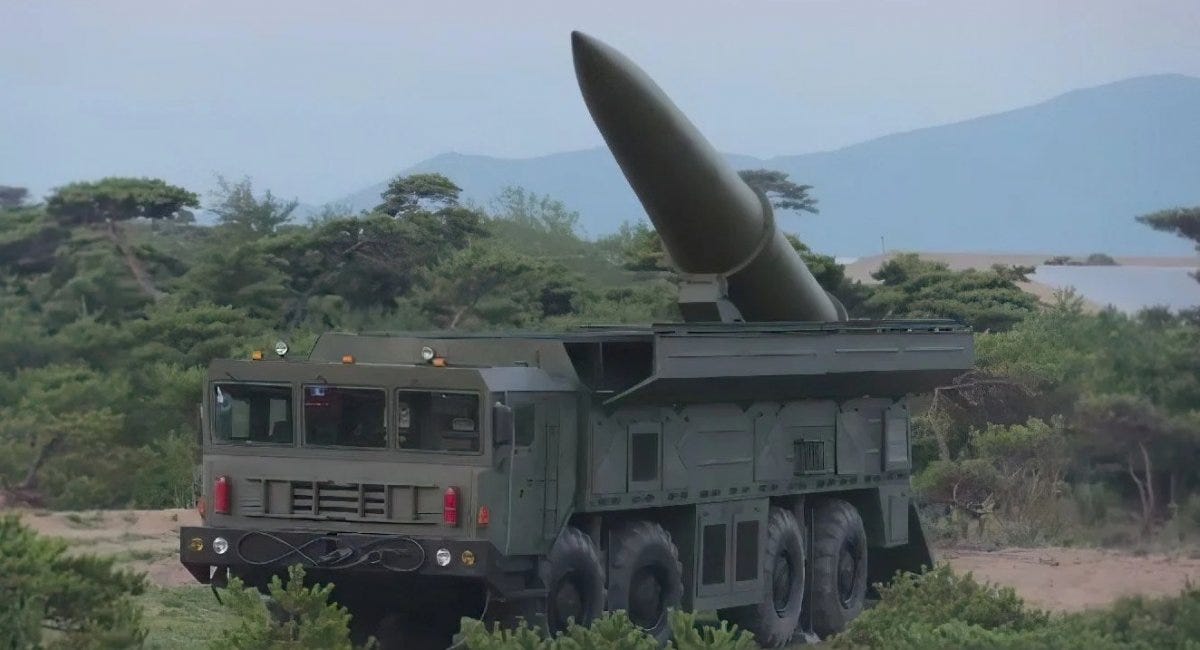
The reported improvement in circular error probable (CEP)—or the range within which 50 percent of shots might be expected to land—appears to have been substantial, regardless. Per Reuters:
Earlier in the war, the missiles had an accuracy of 1-3 kilometres, but the most recent had an accuracy of between 50 and 100 metres, the military source said in an interview in Kyiv on Jan. 27, disclosing a previously unreported assessment for the first time.
This is, of course, not a new report, but the only reason I spotlight it is because its a very concrete demonstration of the advantages of missile operations with reliable data collection in a contested environment of modern warfare for North Korea’s Academy of National Defense Science and the Missile General Bureau.
The point I made on the panel today was essentially that, for a country seeking to build tactical nuclear weapons to achieve military effects (which North Korea certainly cares about), the precision improvements in what appear to be a class of short-range ballistic missiles that are a workhorse platform of sorts for tactical nuclear delivery is a big deal. Targeting hardened aircraft shelters, command and control nodes, missile defense launchers, and an array of other targets with relatively lower-yield nuclear payloads is challenging without a sufficiently high degree of precision. I would add that I do still expect the ongoing Party Congress to heavily zero in on conventional weapons modernization (and conventional precision for missiles) in addition to nuclear modernization.
For a deeper dive, you can, of course, watch the full panel video above. Unfortunately, we’re still waiting on the Ninth Party Congress of the Workers’ Party of Korea to deliver a comparable degree of transparency on military and nuclear modernization plans to the Eighth Party Congress back in 2021.
A few more matters of note:
Mark S. Bell reviews THE NEW NUCLEAR AGE: I wanted to share this review of my latest book ‘THE NEW NUCLEAR AGE,’ by Mark S. Bell, in Ethics & International Affairs:
Ankit Panda has written the most comprehensive and accessible overview of the “new nuclear age” and the dangers it poses for international security. The New Nuclear Age: At the Precipice of Armageddon contends that novel technological developments, long-standing and emerging political disputes between the nuclear-armed states, and the demise of arms control and other tools to control nuclear dangers are all combining to render the emerging nuclear landscape more fraught, unpredictable, and liable to escalation. Panda offers readers an expert (if, as the book’s subtitle suggests, troubling) tour of this landscape. The book is essential reading for anyone seeking to better understand the most worrisome parts and most apocalyptic possibilities of the current and future international environment.
On the post-New START environment: I know some of you have reached out about my views on the expiration of New START. I don’t know that I really want to write up a whole Substack post on the matter, but, to give you something of a sense on where I stand, you may enjoy my recent interview with the chief U.S. negotiator of the treaty, Rose Gottemoeller, for my podcast Thinking the Unthinkable with Ankit Panda (paywalled) for War on the Rocks. You can listen here.
On Chinese nuclear testing. My recent Substack post on the U.S. allegations against China got quite a bit of attention. There’s been much more since, including prominent declassifications by U.S. Assistant Secretary of State Christopher Yeaw:


I intend to write more on this in the coming days.
In the meantime, I’d love to hear from you!
Keep up the effort, Ankit - the right ears are listening.